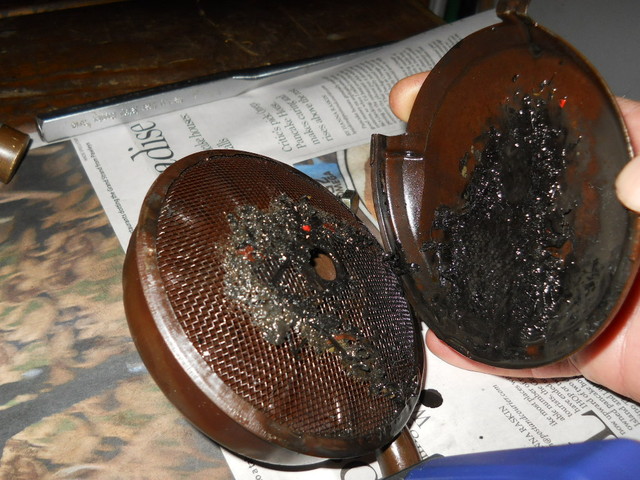
Your opinion: is that a rope seal or not?
Your opinion: is any backlash between crank and cam timing gears acceptable or advisable? (I couldn't find anything on it in the TM) I imagine the machinist can tell me as well.
The four crankshaft flywheel bolts fell out with fingers. The two tapered dowel studs are in there pretty tight (no amount of tapping I did with nuts on them broke them loose, but I didn't get crazy on them). The thread condition and apparent age of all 6 are questionable enough for me to replace all. I'll ask the machinist to take the two studs out and install a new pair. I'll replace the other 4 bolts myself. New nuts and lock washers all around.
The 5th sentence in my copy of TM9-1804A paragraph 81 on page 83 says: "Install the four bolts and two tapered studs in the flywheel flange on the crankshaft."
If your point was not to forget this step unless I want to remove and replace the crank more than once ---- thanks!
 Although I do have "half-heimers" (can't remember sh*t half the time) I've read plenty of threads about consequences of forgetting........I'll let you know how it goes.