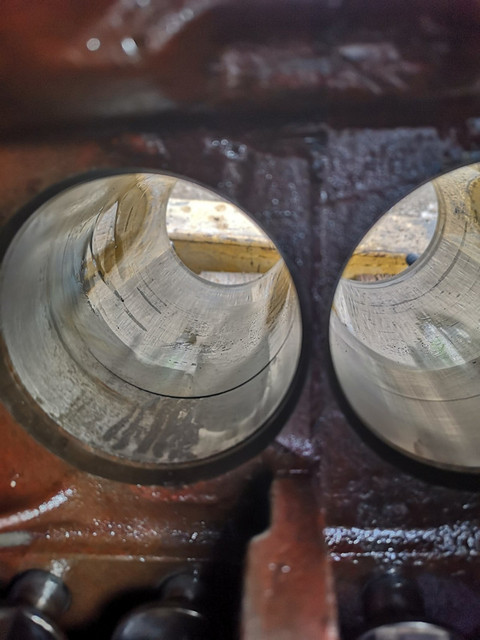
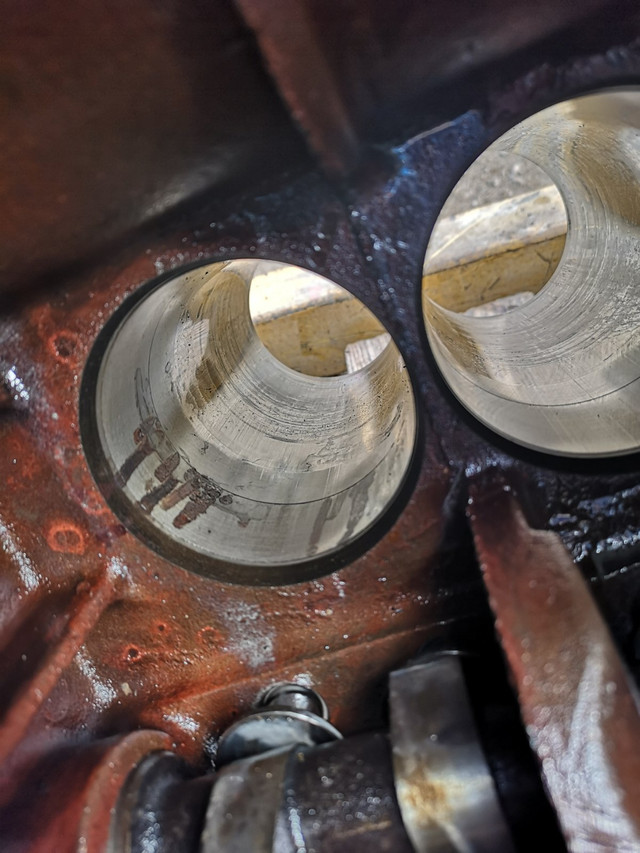
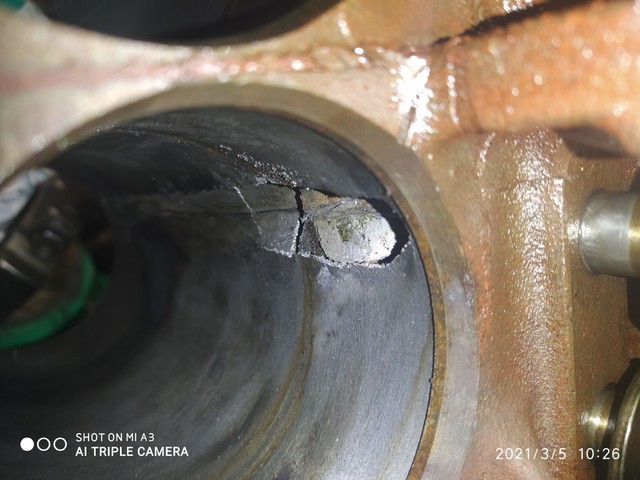
The problem started when suddenly i saw "milky oil"
My first thoyght was that maybe a bad head gasket I took all the engine off and send it to my mechanic.... after a few days he called me.... He said that the problem seems to be more complicated!!!!! I said why?? and told me that someone (the company that i made the restoration) put me two pieces of sleeves That is the first time that he is seeing...... Now the problem is leaking from there
Looks like your block's cylinder bores had issues with leakage from the water jacket area and your restorer elected to sleeve the bores. I don't understand the two piece sleeve attempt. Sleeving has always been an option when builders have cylinder's that exceed available piston oversizes. But not two pieces. I would not waste my time and money on a block with compromised cylinder walls allowing water leakage into the bores.
Choose an engine shop that knows what they are doing. Deliver the engine to them. Their initial advice will probably be what I have said above, "Find another engine". Then ask them is there any other way they can repair the leak. They will probably remove that 2 piece sleeve and inspect the cylinder wall itself, only then can you be offered a final intelligent choice.
Are you sure that it is a 2 piece sleeve? I am not so sure that someone did not just put a short sleeve in instead of going all the way to the bottom. Irregardless, the block should be able to be salvaged. I have successfully sleeved blocks that had holes blown in the parent bore. A few tips on proper installation. The reason that you are leaking is because the sleeve terminates in the middle of the bore. The bore will flex and lose seal and leak. The sleeve MUST go all the way to the bottom past the water jacket to where the block gets solid again. However don’t bore all the way through unless you are installing a flanged sleeve. You need something to hold the sleeve in place, either a flange on top or a step on the bottom. Next is proper press. I have used as little as .001 inch if I am just fixing a flaw in the bore and the block is still intact. I will use about .002 inch if there is porosity or a small crack to help seal better. With a major crack I will go to .003 inch as you are really only holding it at the top and bottom. Green loctite on the bore and sleeve both before driving the sleeve in will pretty much guarantee a seal. Again, make sure that you find a shop that is experienced in installing sleeves and you will be fine.
danrothe2001 wrote:Are you sure that it is a 2 piece sleeve? I am not so sure that someone did not just put a short sleeve in instead of going all the way to the bottom. Irregardless, the block should be able to be salvaged. I have successfully sleeved blocks that had holes blown in the parent bore. A few tips on proper installation. The reason that you are leaking is because the sleeve terminates in the middle of the bore. The bore will flex and lose seal and leak. The sleeve MUST go all the way to the bottom past the water jacket to where the block gets solid again. However don’t bore all the way through unless you are installing a flanged sleeve. You need something to hold the sleeve in place, either a flange on top or a step on the bottom. Next is proper press. I have used as little as .001 inch if I am just fixing a flaw in the bore and the block is still intact. I will use about .002 inch if there is porosity or a small crack to help seal better. With a major crack I will go to .003 inch as you are really only holding it at the top and bottom. Green loctite on the bore and sleeve both before driving the sleeve in will pretty much guarantee a seal. Again, make sure that you find a shop that is experienced in installing sleeves and you will be fine.
To piggyback off Dan's post, I agree that there should have been a shoulder at the bottom of the bore for the sleeve to seat firmly against. Since it appears that your block has been bored straight through, this means that in order to now bore a shoulder into the bottom, your machine shop would have to cut an even larger diameter, and the question arises of how much larger you actually can go before you lose integrity of the cylinder walls entirely.
Here's a Youtube video of "Team G503" installing cylinder sleeves correctly into an L134 block. They do not specify how much the bore was cut oversize, and the link to the Ron Fitzgerald Jeep Parts where the cylinder sleeve was supplied from does not list an outside diameter of the sleeve. The block was bored to a shoulder at the bottom, the sleeve was a press fit of .0015" to .002", and this particular engine builder chose to lubricate/seal the sleeve to the block using Duplicolor clear engine enamel.
wesk wrote:Keep in mind that boring diameters/sleeve thicknesses are also limited by available piston oversizes when not sleeving back to standard bores.
Absolutely. A quick Google search found some anecdotal evidence of an L134 being bored .080" oversize without sleeves. I personally would have concerns for block integrity at anything past .030" without sleeves, however, if someone truly wishes to source .080" oversize pistons, my hat and heart goes out to thee.
The key word in my notes was not referencing the biggest bore. It references the questionable availability of the larger oversized pistons. In other words choose your overbore and sleeve thickness based on what pistons you can find.